

“It is quite lovely – bits of it” – Oscar Wilde
Most of the parts of Edinburgh that we saw were like stepping into the past. They’ve done a good job of preserving the historic architecture, while definitely living in the present. I’d made a list of the areas/points of interest that are considered “musts” when visiting Edinburgh and we used that list to guide our wanderings.
A friend of Yvonne’s had mentioned to her that a couple of areas of Edinburgh held “market days” on weekends. We decided we’d try to visit the one in an area near the North Sea called Leith. We had a “wander-y” sort of route to get there.
But our day started out in search of a place called Dean Village. To get there, we walked along the gardens on Princes Street, which were quite pretty. We saw some great castle views along the way.


This fountain is called the Ross Fountain. It was donated to Edinburgh in 1869 by local gunmaker, Daniel Ross.

Yvonne was pressed into service as our photographer so we could get a picture with both of us in it -without it being a selfie.
This was a cross near St. John’s Church. It was erected in 1879 as a memorial to a long serving minister named Edward Ramsay. The sign with Trump in the background was some sort of political statement.

Our phones said…Turn right here: The Caledonian hotel was opened in 1903 for passengers arriving at the Princes Street Railway Station…which is no longer there.

After walking through a more residential looking area, we turned left at this old building. It is called Kirkbrae house. It was built in the 1680s as a tavern, but has lived through many changes over the years. What we couldn’t see from this angle is that the building has several more levels going down the hill that it sits on the edge of.

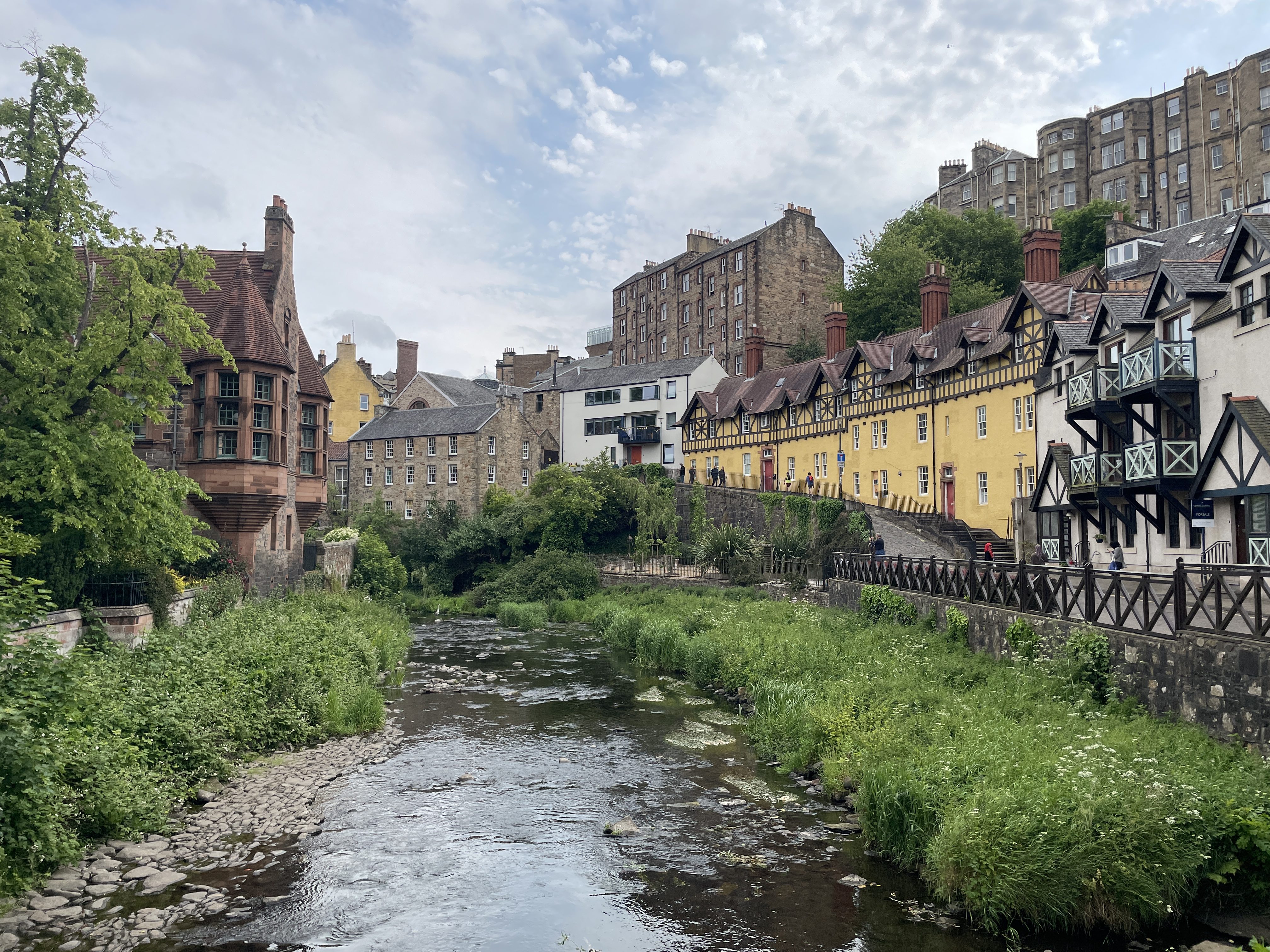
It wasn’t much further before we crossed a bridge and entered the Dean Village area. Dean Village is a picturesque area along a small river (called Water of Leith) that was a successful milling area for more than 800 years. At its peak, there were at least eleven mills operating in this area. It didn’t take long to walk through.

It is hard to see, but there’s a bridge (where the people are standing) that overlooks the river.

This picture (below) is taken from the bridge looking toward the side of the river we’d approached from.

After we crossed the bridge, we followed some steps down to a sidewalk along the other side of the river. This is looking back at the bridge.

This is looking back toward the bridge, which was now around the bend to the left. I was standing on a smaller bridge that we crossed over, then went down some steps to a path along the river.

The path entered an area that was more like a nature walk. We saw this bird, then the dam. Even though I’m pretty sure that we could have followed this “path” all the way to Leith, just after the dam there were signs for Leith that took us up some stairs and out onto the street.


We had picked going to Leith because of the lure of “market day”. Mike and I had seen some market days in France when we were there and really enjoyed looking at the food and other things for sale. We ended up having to walk a long way to even get to Leith! (It wasn’t especially scenic!)
When we got to Leith, we found a place to eat lunch and take a rest stop – by then we’d walked about 8 miles. After lunch, we found the market and it was perhaps 12 small stands -a mix of produce, art & craft items. We all agreed that it was a bit disappointing. Especially after walking that far. I didn’t even think to take a picture !!
Leith is the port area of Edinburgh. It was originally a town on its own, but was absorbed into Edinburg in the 1920’s. This was a cute sculpture by a marina.

As it turns out, by then we weren’t far from the Royal Yacht Britannia, which is berthed in Edinburgh, so we thought – in for a penny- and went to look for it. The yacht, used by Queen Elizabeth II and other royals, was decommissioned in 1997 and is now a tourist attraction. It was strangely hard to find. After a comedy sketch of wrong turns and backtracking, we finally figured out it was hidden behind (and very much an integrated part of) a shopping mall. Trying to just get a look at it without buying tickets to tour it also ended up being a bit disappointing. They have it blocked off in a way that you can’t just get a “glamour shot” of it at the dock. But we saw enough of it to say we did. The picture below was as close as we could get on the water side of the mall.

Luckily, there was a stop for Edinburgh’s tram conveniently located directly across from the mall. Three tired walkers took the easy way back to our part of town! We exited the tram on Princes Street and only had about a 1/2 mile walk back to our hotel.
Day 3 – Edinburgh
On our last day, the weather was going to be alternately sunny and rainy. Fairly early in the morning, we were on our way to visit Victoria Street. We walked up the Royal Mile for a short way, then took a side street to reach Victoria Street.
Victoria Street is the result of road construction in the 1830s. The purpose was to make the existing road more accessible to other new road construction in the area. It is popular because of its curvy design and colorful buildings. It is claimed that Victoria Street was the inspiration for Diagon Alley in the Harry Potter series.


This picture shows the street curving to the left to where it ends.

Around that corner to the right (in the above picture) is an area called the Grassmarket -which we didn’t explore much… But I liked that we walked by the “Smallest Pub in Scotland”.

In the late 1400s the Grassmarket was an area of open markets, along with cattle and horses for sale (hench the “grass” part of the name). It was more or less the “poor area of town” for the next 500-ish years. Up until 1784, it was also a prominent site for public hangings. It is only recently that the area has been gentrified and is now popular with tourists -mainly for dining, pub hopping, and small shops. The original Grassmarket covered more area than just one street, but the road we walked on briefly is named Grassmarket Street.
Not far from Victoria street was Greyfriars Church and graveyard. We wandered over that way to see the statue in honor of “Greyfriars Bobby”.

Bobby is a famous dog who lived in Edinburgh between 1855 and 1872. The story is probably more folklore than true, but it is said that Bobby’s “human” worked for the city police as a nightwatchman. The night watchman sort of befriended Bobby, who may have been a stray. Another version says that the night watchman bought Bobby. Either way, Bobby started following his “human” on his nightly rounds. The nightwatchman died in 1858 and was buried in Greyfriars Cemetery. As the story goes, Bobby guarded the nightwatchman’s grave for the next 14 years, only leaving to find food once a day. When Bobby died, he was buried in the cemetery not far from the nightwatchman’s grave and the rest is history.
You can see Bobby’s statue in the background. People leave a stick on his grave -that’s something a dog would like better than flowers.

Over the years, people have tried to research to find out what the true story might have been, but haven’t managed to debunk the story. The legend of Greyfriars Bobby is now folklore. Bobby’s story brought in tourist dollars -so it was beneficial for the cemetery’s caretaker to promote the story. One writer even suggests that Bobby died before 1872 and was replaced by another dog trained to stay by the watchman’s grave, so that people could come see the loyal dog guarding the grave.
Outside of the cemetery, a water fountain with a Bobby statue ton top was donated in 1872 by a philanthropist who was charmed by the story. People rub the statues nose for “luck”.

Not far away from the water fountain is the Greyfriars Bobby Pub… established in 1893.

Today was check-out day, so we had to get back to the hotel to check out. On the way I took a few more photos…


I walked into a couple of the “closes” to see what was in there…


As mentioned above, it was check-out day. Yvonne’s flight was late that evening; Mike’s and mine was the next day. We were booked into a hotel at the airport for the night so that we’d be walking distance for our early check-in time the next morning. After we checked out, we asked the front desk to hold our bags so that we could go to lunch. After lunch, it was still too early to head to the airport, so Yvonne and I decided to visit the National Museum. Mike opted out of that excursion and volunteered to sit in the hotel lobby with all of our bags.
The museum was nicely done. They had many displays of historical artifacts in different categories, like furniture, bikes, aircraft…etc. We only gave ourselves an hour or so to be there, so we were moving fast! After, we returned to get our luggage and, oh yeah, Mike!…we walked to the nearest tram stop. It was about 1/2 mile away. At our airport hotel, we checked in and spent our remaining hours together enjoying each other’s company -plus dinner.
Even though I didn’t give us enough time to really do Scotland justice, I did enjoy seeing the places we did visit. We flew away with me having some very good ideas of where we’ll go the next time we find ourselves in Scotland!

Categories: Edinburgh -Part 2
Thanks, Terry, very enjoyable to “tag along” on your trip via your posts! The castle and river and random city photos are so picturesque. The trip to Keith made me tired just reading it! I would have loved touring the Britannia. I remember reading how sad Queen Elizabeth was when they retired it since it was such an important part of her life/reign. Are the brick streets original? They look in such good condition.