



“When in a museum, walk slowly but keep walking” – Gertrude Stein
Since Mike isn’t generally fond of bigger cities in Europe and he’s seen most of the big things in London – I suggested we try visiting the British Museum. Usually when we’re traveling to new places we’re too busy and rushed to spend time in museums. On this trip we were looking for something new to do and I thought the museum would be a good option. Maybe not –considering it was Saturday, possibly Spring Break time in England, and the museum is free! Yes, it was quite crowded.
There are two things I’ve always wanted to see if I ever made it to the British Museum: 1. The Rosetta Stone and 2. The Elgin Marbles…or Parthenon Marbles as they now seem to be referred to as. Mike wanted to see mummies. We had to take the Tube from our base camp hotel to the museum –it took about 1 hour. We had a short walk from the station to the museum through a pretty park and then joined the fray.


We started out just wandering a bit without an agenda because we wanted to get a good idea of what is on display there. It turned out to be a bit overwhelming –because the British Museum has A LOT of things on display. I found the displays a bit confusing because these displays seemed to be more about grouping similar items together -like all jewelry or all textiles. It is beautifully done but the sheer quantity of items on display is quite overwhelming -at least to me.
After wandering through several galleries randomly, we decided to take a break to find a spot to sit down, get a cold drink, and regroup. We looked up where the Rosetta Stone and the Marbles were located in the museum and decided to focus on seeing those things next and then look for mummies.
We stumbled across the Rosetta Stone first. The crowd around it gave me flashbacks to seeing the Mona Lisa in Paris.

I patiently waited until I could get my picture (below), but it was tough because I’m not known for being patient!

The excitement about the stone is that in the time of Ptolomy V in Egypt, a proclamation was made declaring the divine cult of the new ruler. The proclamation was written on the stele in 3 languages: hieroglyphics, Demotic (which was a form of Egyptian script of the time) and Greek. Having the Greek and Demotic versions to compare against the hieroglyphics provided scholars with a key for deciphering hieroglyphics in general. That’s the basics –there’s more about it on line if you Google.
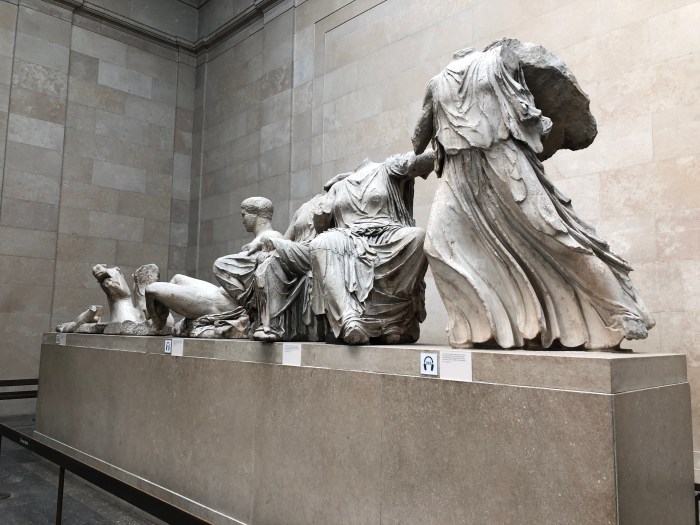
Next we located what I’ve always thought were known as the Elgin Marbles (after the Earl of Elgin who brought them to England) but I noticed that the museum calls them the Parthenon Marbles. It is quite a display. There are about 135 sections that were originally part of the Parthenon in Athens, Greece.




After seeing the Marbles, we went in search of mummies. We saw a nice display of Egyptian artifacts and one or two mummies.

These were in the same general area, but I’m pretty sure they’re not of Egyptian origin.


The British Museum reflected in the window of the Museum Tavern
After that –we headed back to our hotel to get some peace and quiet!