

While we were still in France, I got an Email from a friend of ours, Yvonne, who is from Ireland. She asked what we were planning to do while in London and mentioned she might like to come meet up with us. I thought that was a great idea, but warned her that we were going to be total tourists. She said that was fine with her because while she’d been to London several times -she’d never taken the time to do all the tourist things.
Just before we left for London, I got an Email from her saying she’d booked her trip to London and quote: “That will teach you not to put so much information on Facebook!” That made me laugh.


A quiet morning on the Seine – a last picture of the view from the room.
Laura, Gail, Elton and I took a taxi to the Gare du Nord train station in Paris on Saturday morning and went through the process of preparing to board the Eurostar train. There was security similar to getting on an airplane, plus a customs/immigration stop. We were looking forward to the experience of passing through the Channel Tunnel.

Waiting to board
The Eurostar train hits speeds up to 186 miles/hour, except through the tunnel where the speed limit is 100 miles/hour. We spent the 2 1/2 hour trip watching the scenery go by in a blur, dozing, reading and playing with our iPads. We entered the Channel Tunnel somewhat unceremoniously – suddenly the view was gone and replaced with blackness. I had wondered how claustrophobic the tunnel would feel -but since it is only about 32 miles long and we were going 100 miles an hour -it seemed like we re-emerged into sunlight on the England side in the blink of an eye.


The first order of business upon arriving at St. Pancras Station in London was to go next door to King’s Cross station and find Harry Potter’s 9-3/4 platform for a picture. There was quite a line of people waiting their turn to pose …so Laura simply took a picture from the side.


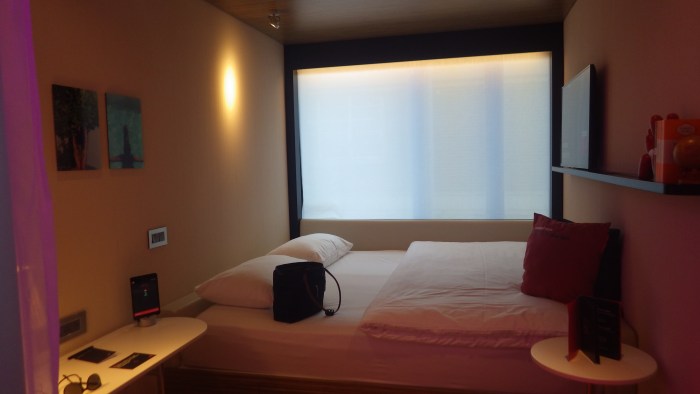

Just across from the shower door was a very narrow sink vanity which also had a small refrigerator at the end next to the chair/table by the bed. Behind this shower “pod” was a small closet, with safe…and the door to the room. As I said -it was small, but I think it was pretty efficient for one person.
We had to wait to check-in, so we had them store our luggage and grabbed a quick bite to eat in the lobby. What was available was not to my liking and that was the only time we chose to eat at the hotel. After that we walked outside to look around while I was trying to find Yvonne. There is a partial remains of a Roman wall adjacent to the hotel on one side. There is a large sundial just outside, decorated with plates commemorating the history of London…and of course -over there- the Tower of London!


It worked out great. Yvonne had gotten there before us and walked to a nearby outdoor store for some shoes. She was just getting back to the hotel when I called her and was actually not far from where we were standing in a park next to the hotel.


The Tower was founded toward the end of 1066 as part of the Norman Conquest (we cross paths with William the Conqueror once again). William wasn’t the first to choose this location for a stronghold (there were Roman ruins here) -but he was the last.
The white tower was built by William the Conqueror in 1078. It was considered a symbol of oppression by the resident British. Originally, stone from Caen, France was imported to clad the exterior walls, but there isn’t any of that stone left on the tower.

These days the tour guides and guards of the Tower are the Yeomen Warders. They have been the Royal Bodyguard since at least 1509. Current “Beefeaters” (as they are also called; although the reason for the nickname is lost to history) are former active duty military service members. They can’t apply for the position of Warder unless they have served for more than 22 years, and have earned the Long Service and Good Conduct medals. They live inside the fortress with their families -they have to pay rent!


The Tower has served many purposes in addition to being a prison…an armory, a treasury, a menagerie… For a while it was the location of the Royal Mint. It also is where the crown jewels of England are kept – they have been on display there since 1669.


Laura shopping around for some ideas to put on her Christmas list!
By the 1500’s the use of the Tower as a royal residence was waning. It was also during the 1500’s and into the 1600’s when its use as a prison became prevalent. Even though there’s a reputation of it being a place of torture and death, only 7 people were actually executed within its walls, Ann Boleyn being one. Most of the executions were done on Tower Hill (the site was located in a park next to our hotel.) There were 112 executions there over 400 years.
Here are some pictures from the day:

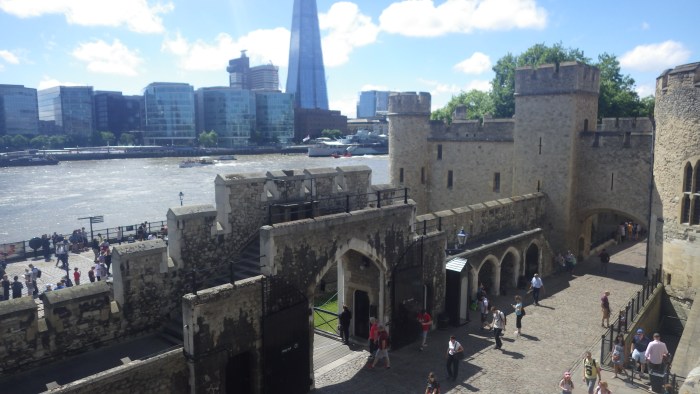


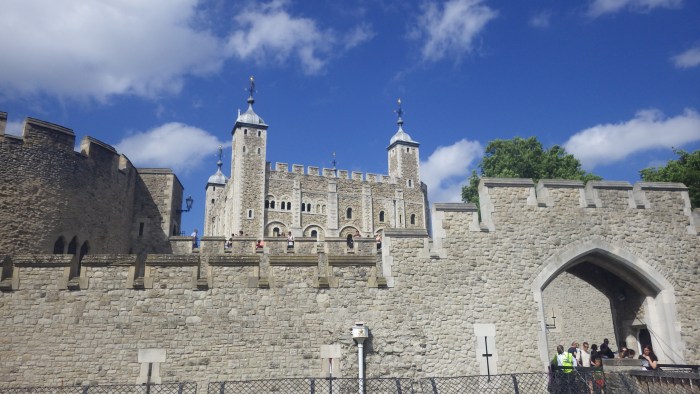


They have quite an extensive display of armor from different eras.


Armor for King Henry VIII.
In addition to the Yeomen Warders, the other famous inhabitants of the Tower are 6 ravens. There is a Raven Master who cares for them. They eat fruit, cheese and meat. It isn’t known how long the ravens have lived at the Tower, but they are recorded as being there around 1650 during the reign of King Charles II. It is said that the tower will fall and disaster befall the kingdom if the ravens ever leave. So strong was this belief that when it was complained that the ravens were interfering with the work at the Tower Observatory, King Charles moved the Royal Observatory to Greenwich rather than remove the ravens. It is traditional to have at least 6 of the birds living there. The last time I was there, the ravens were in an outdoor setting on the grounds. This time -I didn’t see them, but Gail got a picture of them in the cages.

Their wings are clipped, but occasionally a raven manages to go astray. There was one named Grog who deserted his duty at the Tower in the early 1980’s to hang out at a local pub called the Rose and Punchbowl. Ravens have a long life span. According to the records, the longest living raven at the tower died at 44 years old.

The Traitor’s Gate. The story goes that some prisoners arrived at the Tower via this water gate (to the Thames), but apparently it’s more story than fact.


There was a great view of Tower Bridge from the river side of the Tower. The Tower Bridge is a working draw bridge. It was built in the late 1800’s.


By the time we were done touring the Tower, it was time to find our luggage and then dinner. We walked to a nearby restaurant and grabbed a bite to eat.
On the way we saw one of the markers for the city limits for the actual, original, City of London -which is essentially the area that the original Roman walls enclosed. Once again we managed to be staying very near to the spot where the City was founded. The City of London is approximately 1 square mile. Greater London encompasses something like 600 square miles!


Sometimes you’re walking along and you see something pretty or interesting, yet have no idea about “what” it is you’re looking at. This church is called All Hallows-By-The-Tower and it was founded in 675! William Penn (of Pennsylvania fame) was baptized here in 1644. John Quincy Adams was married here in 1797. It has undergone many changes over the years. It was hit pretty hard in WWII, but there are still parts of the building that date way back. I’m sad that we weren’t able to see the inside of it because it wasn’t open at the times we were nearby to it.


Our rooms at Citizen M came with a free drink voucher at their 7th floor lounge (with a view!)


